The Greek language and its speakers
Greek and Chinese are the only languages still known to us after 3500 years that are still spoken today. They are not the only languages of culture that have been spoken and written for many centuries - some of which are still in use today, others dead, such as Sumerian, Egyptian - but they do have a longer history and have had a greater influence. There is not doubt that, if judged by the influence it has had on all of the European languages, and continues to have today on all languages, Greek can be regarded as the most important language in the world. The direct or indirect influence of its alphabet, lexicon, syntax and literature has been and is immense.
The First Greek speakers
A hard task in history is to define who the first Greek speakers were and how they emerged. First of all, the term Greek/Hellenic is something that cannot be used as an ethnonym in the prehistory of the early speakers of this language. Neither can early written forms of Greek set a date to the formation of the ethnogenesis, the language and the culture of these people. In the last centuries many scholars have tried to bound language and archaeology into a date that would signify the so called 'coming of the Greeks'. There are still questions that remain unanswered and others that have more than one explanation.
A good starting point is the prehistory of the Helladic area and the places that the first Greek speaking people appear. As early as the 19th century, Paul Kretschmer drew scholarly attention to the fact that the suffixes -nth- and -ss-, are often attested in place-names in the Greek mainland, Crete and Asia Minor. Those could not be identified as Greek, and should be taken as pointing to the existence of a pre-Hellenic linguistic substratum. Later in 1928, J. Haley and C. W. Blegen, in their seminal article ‘The coming of the Greeks’, showed that the distribution on the map of Greece of the geographical names identified by Kretschmer and others as belonging to the pre-Hellenic substratum closely corresponds to the map of distribution of Early Bronze Age archaeological sites. This allowed the authors to associate the pre-Hellenic substratum with the people who inhabited Greece till the end of the Early Bronze Age and to move the date of the possible Greek arrival in Greece, formerly believed to have taken place ca. 1600 bc, to the beginning of the Middle Bronze Age (ca. 2050–2000 bc). The linguistic identity of those pre-Hellenic people that gave those names to various places point east and specifically to the coast of Asia Minor. The suffixes -nth- and -ss- on the basis of which it was identified are closely paralleled by the suffixes -nd- and -ss- of the languages of Asia Minor attested in the Classical period, such as Lycian, Lydian and Carian. The discovery and decipherment of Hittite and other Bronze Age Anatolian languages has shown that they are closely related to the languages of Asia Minor and that the suffixes -nth- and –ss should be identified as typically Anatolian (Pre-Indo-European or Luwian). For the Luwian hypothesis there were two groups of scholars representing the view:
- Those who believed that the Helladic area had a limited Luwian-speaking population that was enough though to affect the place names.
- Those who believed that the Greek mainland and even Crete, was predominantly Luwian-speaking and became even more dominant with the import of grey wares from Anatolia in the 20th century BC.
Nevertheless, those Luwian theories are rather old. All attempts of linking the pre-Greek substratum with an Indo-European language have failed. Currently, it is suspected that the pre-Greek population of Greece was not an Indo-European speaking populationBeekes RSP, "Pre-Greek is Non-Indo-European" in "Pre-Greek: Phonology, Morphology, Lexicon", 2014 Leiden Ch. Symeonidis: "Pre-Greek and Ancient Greek onomastics: Place-names and personal names from Macedonia and Thrace and Greek dialectology", Thessaloniki 2015, International Conference The Linguistic Map of Central and northern Greece in antiquity, Thessaloniki 2015. , but a group of people speaking an isolate language or a language related to the pre-Indo-European languages of Anatolia (e.g. Hattic, Hurrian). However, this is something that will not be discussed in detail here, as it needs a dedicated pre-Greek article.
In the second half of the 20th century, theories on the early Indo-European origins (including Greek) emerged. Two of them are dominant today and create mysterious scenarios about the first Greeks:
- The Kurgan Hypothesis proposed by Marija GimbutasGimbutas, Marija. "Proto-Indo-European culture: the Kurgan culture during the fifth, fourth, and third millennia BC", 1970., who defined the 'Kurgan culture' as composed of four successive periods, with the earliest Kurgan I dating in the early 4th millennum BC.
- Reinfrews Anatolian hypothesisRenfrew, Colin. "The origins of Indo-European languages.", Scientific American 261.4 (1989): 106-114. which suggests that the speakers of the Proto-Indo-European language lived in Anatolia during the Neolithic era, and associates the distribution of historical Indo-European languages with the expansion during the Neolithic revolution during the seventh and sixth millennia BC.
The Kurgan hypothesis took is name from the Tatar word for tumulus/burial mound. Indeed a culture like the Greek, that built tumulus graves from the time of Agamemnon to the time of Philip II of Macedon, could fit into this hypothesis. These newcommers entered the Balkans during the Secondary Urheimat period (2300 BC) and reached Greece, to give birth to the proto-Greek language. The Anatolian hypothesis was proposed by Colin Renfrew and suggests that Europe became IE-Speaking with the spread of farming, that passed from Anatolia - to the Balkans and to Europe. Indeed, around 6000 BC the Helladic area shows signs of a migration that brough farming into Thessaly, Epirus and Macedonia. Such a wave moved also towards the Aegean islands and Crete. The problem with the Reinfrew hypothesis is that it is dated way back in time and even though it works in terms of archaeology, it gets complicated in terms of linguistics. Those 2000 extra years that separates it from the Kurgan hypothesis, would result a greater number of IE languages than what we currently know. Another problem is that non-IE languages were spoken in Anatolia before the rise of the Hittite empire. Two of them are attested, namely Hattic and Hurrian, but certainly more existed in west Anatolia and Pontus. The ancestors of the MinoansFernández, Eva, et al. "Ancient DNA analysis of 8000 BC near eastern farmers supports an early neolithic pioneer maritime colonization of Mainland Europe through Cyprus and the Aegean Islands.", PLoS Genet 10.6 (2014): e1004401. Paschou, Peristera, et al. "Maritime route of colonization of Europe.", Proceedings of the National Academy of Sciences 111.25 (2014): 9211-9216. were also part of those migrations and from what we know so far from the Linear A tablets left to us, there are no signs of an Indo-European language spoken in pre-Mycenaean Crete.
None of those two theories help us to identify the first Greek speakers nor date their first presence. It is like asking "where were the English when Julius Caesar invaded Britain"? There's no answer to that. To talk about the 'coming of the Greeks' means that we suppose the pre-existence of the Greek language outside Greece, a hypothesis for which there is no evidence. The motherland of the Greek language has always been, the area of the present state of Greece. Just like modern English was formed in England out of Anglo-Saxon heavily contaminated with Norman French and other foreign bodies. The traditional view of waves of Greek-speaking warriors marching down the Balkans to subjugate Greece is an old one.
Besides, the Greek people have very old memories of their history. For example they knew specifically that Cecrops became King of Athens in 1582 BC. The end of the 3rd millennium BC is not that far away from that date and logically they would remember their comming, but they don't. In many cases some of the Greek tribes like e.g the Ionic ones were described as indigenous by ancient historians Herodotus Book 1 chapter 56. Ionians spoke undoubtedly Greek and their dialect evolved by time to become the modern Greek language. Other Greeks appear later but they move from places that are inside Greece and not outside. The Greeks also knew that some of their countrymen spoke other languages (e.g Eteo-Cretans - meaning true Cretans) or that people they lived with side by side were not originally Greek (e.g the Carians, Leleges).
In 1963, Chadwick was the first to propose that the Greek language did not exist as we know it before the 20th century BC, but was formed by the mixture of an indigenous population with invaders who spoke another PIE dialect/language. When these newcomers (mello-Greeks) reached Greece, they mixed with the previous inhabitants, whom they succeeded in subjugating, and borrowed from them many words for unfamiliar objects. The mispronunciation of the PIE words by those aboriginals led to permanent changes in the phonology. Both the indigenous inhabitants and the newcomers started to form a group that would in the future become the Greeks. Future discoveries might throw some light into the Greek language prehistory. What is certain right now, is that the first Greek speakers had a multi-ethnic/lingual prehistory. In other words the fusion of cultures and languages of the Greek mainland and the Aegean starting from the neolithic period until the Trojan war has been the mother of the Hellenic tongue.
The Proto-Indoeuropean dialect before Greek
The only major post-Anatolian branch that is difficult to derive from the steppes is Greek. One reason for this is chronological: the PIE Pre-Greek dialect probably split away from a later set of developing Indo-European dialects and languages, not from Proto-Indo-European itself. Greek shared traits with Armenian and Phrygian, both of which probably descended from languages spoken in south-eastern Europe before 1200 BCE. Greek shared a common background with some south-eastern European languages that might have evolved from the speech of the Yamnaya immigrants in Bulgaria. The PIE Pre-Greek dialect also shared many traits with Indo-Iranian. This linguistic evidence suggests that the PIE Pre-Greek should have been spoken on the eastern border of south-eastern Europe, where it could have shared some traits with Pre-Armenian and Pre-Phrygian on the west and pre-Indo-Iranian on the east. A number of artefact types and customs connect the Mycenaean Shaft Grave princes, with steppe or south-eastern European cultures. These parallels included specific types of cheek pieces for chariot horses, specific types of socketed spearheads, and even the custom of making masks for the dead, which was common on the Ingul River during the late Catacomb culture, between about 2500 and 2000 BCE. It is very difficult, however, to define the specific source of the migration stream that brought the Shaft Grave princes into Greece. The people who imported the PIE Pre-Greek dialect to Greece might have moved several times, perhaps by sea, from the western Pontic steppes to south-eastern Europe to western Anatolia to Greece, making their trail hard to find. The EHII/III transition about 2400-2200 BCE has long been seen as a time of radical change in Greece when new people might have arrived.
The pre-Greek world of the neolithic Balkans
As mentioned before the Proto-Indo-European speakers who entered Greece in late 3rd millennium - early 2nd millennium BC were not the only inhabitants of the Helladic area. Before them the neolithic people of the mainland, responsible for the Anatolian-like toponyms lived there. So, how did Neolithic culture spread through the Balkans? There are many shades of opinion between the two extreme views; one that there was a complete migration of peoples on a large scale into the Balkan Peninsula, and the other that the Neolithic culture of the Balkans was entirely autochthonous. One must bear in mind when dealing with this problem that the Balkan Peninsula had been inhabited in the Mesolithic and Pre-Neolithic periods and that the descendants of these inhabitants, no doubt, took part in the formation of Neolithic culture (e.g in Thessaly - Macedonia). On the other hand one has to stress that a large number of Neolithic phenomena in the Balkans such as the growing of corn and the domestication of animals are part of a wider cultural complex, within which there existed basic local differences and variants. It seems therefore that the most acceptable view is that the Neolithic revolution and the diffusion of Neolithic culture were the result of closer contacts between the inhabitants of a wide Balkan-Anatolian area, and in particular that new achievements of culture and economy originally made in the Near East were transferred to the Balkan Peninsula.
The early developments of Greek language and culture
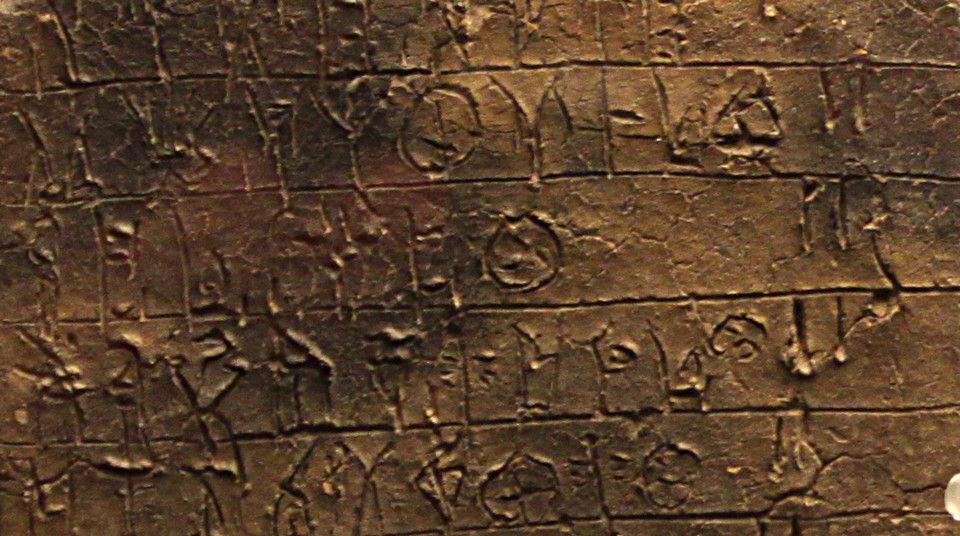
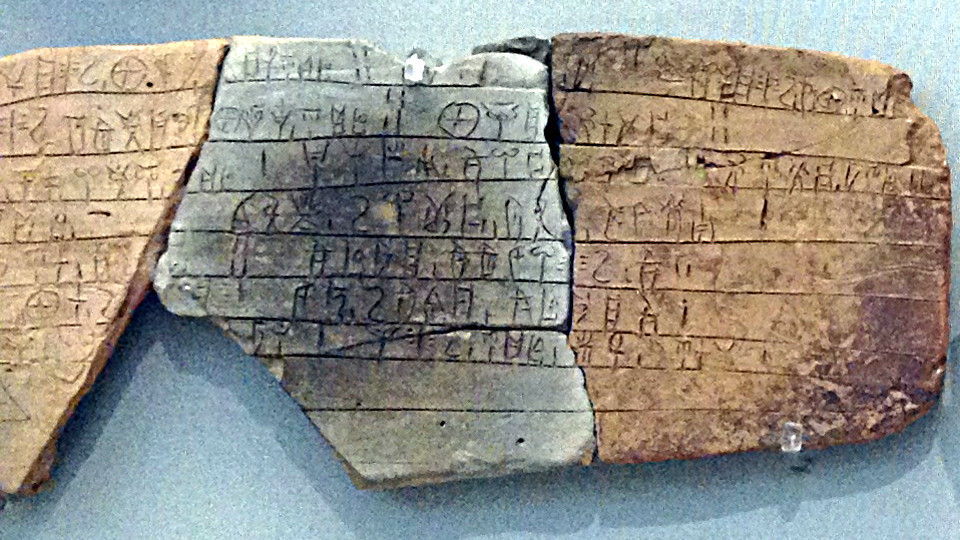
We will now move forward to a possible reconstruction of what happened between the 20th century BC and the 12th. The period starts with the possible incursion of warlike people possessing the horse that establish themselves in the north and central Greece. Their mixing with the various indigenous people gives birth to the Greek language which becomes dominant in the Greek mainland. The islands according to ancient historians are dominated by Cretans and in some cases by the Carians, who we know to live later in south-western Anatolia. We don't know when the Greek-speaking people of the mainland entered the Aegean world. We know for sure that with the presence of Linear B in Crete, the proto-Greeks were already there. If the particular form of script evolved from its predecessor Linear A then there must have been a period where Linear A was reconstructed to be used with the early Greek language. Also, the Minoan society of Crete cannot have immediately adopted the political system and structure that was brought by the newcomers and that is revealed in the Linear B tablets. That leads us to the conclusion that the early Greeks reached Crete much earlier than the earliest Linear B tablets. Since data is absent some scholars cannot avoid to think of the possibility that Linear B was spread to the mainland, by immigrants that survived the Thera eruption.
In the 16th century BC, the mainland is dominated by this new society whose people can rightfully be called Greeks. Unlike the peaceful Minoan society, those people are warlike and posses a well organised political system. The economy is mainly based on trade and specifically on the trade of an aromatic ointment that is the ancestor of todays soap. A trading economy required a lot of bureaucracy and logistics - a reality that resulted written language. The dominant language is the Greek as depicted in the Linear B tablets.
During same period the ancient Greek traditions mention that people who were formerly known as Graikoi (Greeks) were renamed to Hellenes The Parian chronicle. Meanwhile, a tribe known as Selloi, who inhabited Epirus in northwestern Greece, adopted the name as well. Graikoi and Hellenes became the first ethnonyms that later united the Greek speaking people until today.
The same socio-political system continues to be the dominant one in southern and central Greece until the 12th century BC, while the northern areas seems to follow primitive ways of life, with few exceptions in southern Thessaly and Macedonia. At this point the Trojan war begins and the first migrations of Greeks to the Anatolian coast occur. In Homers Iliad, however the united Greeks/Hellenes belong still in tribal divisions like e.g the Acheans and the Danaoi. The Hittite records mention their Greek-speaking neighbours as Ahhiyawas (Acheans). This leads us in the conclusion that panhellenic ethnic unity under one name does not exist until the first Olympics in the 8th century BC.
The 12th century BC became the downfall of the Mycenaean era and the start of the Greek Dark ages. This is often connected with a problematic invasion of Greek-speaking tribes from the north, that take over the Mycenaean incumbent. Writing of Greek at any form ceases to exist, which makes it impossible to follow the development of the language until the appearance of the alphabet. During these centuries, the homogeneous Mycenaean Greek, was divided into dialects that were distributed geographically.
The Greek dialects and their distribution
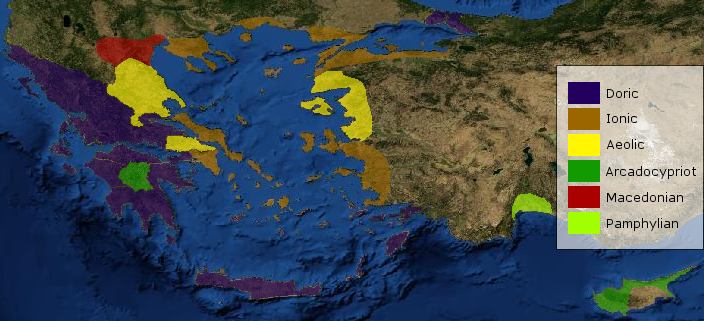
As mentioned above, the Greek dark ages leave us no trace on how the Greek language developed. With the appearance of the alphabet in the late 9th or early 8th century BC, our first encounter with the meta-Mycenaean Greek is the Homeric, named after Homer - the author of the Iliad and Odyssey. This kind of Greek however, is a mixture of dialects that developed in the dark ages, such as Ionic and Aeolic. The migrations and the geographic isolations of the Greeks between the 12th and 8th century BC, differentiated the Mycenaean Greek and formed a group of dialects - so called Hellenic languages. Those are the following:-
Attic - Ionic - spoken in various locations depending on the period, but mainly in
Athens, the cycladic islands, Chalkidike, the coasts of Thrace and Asia Minor. It is conspicuously lacking in early innovations
peculiar to itself. It shares a number of mainstream developments with West Greek and the modified preposition ενς (εις, ες)
with Doric. Its emergence as a distinct dialect can hardly significantly antedate the West Greek transgression and may well be
a result of it. Attic had the closest contact with West Greek.
-
Aeolic - spoken in Thessaly, Boiotia, the island of Lesbos, the central and northern
coast of Asia Minor. It was a bridge dialect between east and west Greek, having Thessaly as the area of its origin. Some weak
isoglosses join it to Arcado-Cypriot.
-
Doric - spoken in western Greece, Epirus, Peloponnisos and Crete. It is distinguished
from East Greek by its broadly conservative character.
-
Arcadocypriot - Spoken in the area of Arcadia in Peloponnisos, Cyprus and maybe western
Crete. It clearly continued a form of the Mycenaean dialect, but took its starting point from a more advanced stage than that
attested on the Linear B tablets.
-
Macedonian - Macedonian is usually placed by modern scholars as a branch of its own within the Hellenic languages. Some scholars avoid to classify it until further evidence is available. Spoken in ancient Macedonia, Northern Greece.
-
Pamphylian -
An aberrant and very peculiar dialect of Greek which has proved hard to classify within the framework
of the conventional dialect groupings (similar status to Macedonian). Inscriptions are rather hard to understand.
Spoken in Pamphylia (meaning 'land of all tribes') in the southern coast of Anatolia (Antalya).
The Greek alphabetNot including local varieties
| Letter | Transliteration | Standard sound in 450 BC as in | Modern Greek sound as in |
|---|---|---|---|
| Α α alpha | a | “cat” | (same) |
| Β β beta | b | “bet” | “vet” |
| Γ γ gamma | g | “get” | “yet” before i, e - [γ] before a, o |
| Δ δ delta | d | “dog” | [ð] “that” |
| Ε ε epsilon | e | “get” | (same) |
| Ζ ζ zeta | zd | “wisdom,”“glazed” | “zero” |
| Η η eta | ē | “hair,” Fr. “grève” | [i:] “meet” |
| Θ θ theta | th | “tin,” Hindi “thali” | [θ] “thin” |
| Ι ι iota | i | “meet” | (same) |
| Κ κ kappa | k | “skip” | (same) |
| Λ λ lamda | l | “lap” | (same) |
| Μ μ mu | m | “map” | (same) |
| Ν ν nu | n | “nap” | (same) |
| Ξ ξ xi | ks | “tax” | (same) |
| Ο ο omicron | o | “top” | (same) |
| Π π pi | p | “spot,” Fr. “père” | (same) |
| Ρ ρ rho | r | “rat” (probably trilled) | (same) |
| Σ σ ς sigma | s | “sip” | (same) |
| Τ τ tau | t | “stop,” Fr. “tante” | (same) |
| Y υ hypsilon | u | Fr. “tu,” Ger. “müde”4 | [i:] “meet” |
| Φ φ phi | ph | “pin” | [f] “fin” |
| Χ χ chi | kh | “kin” | [x] Span. “ajo” |
| Ψ ψ psi | ps | “lapse” | (same) |
| Ω ω omega | ō | “paw” | “top” |
| Ϝ ϝ digamma | w | “Wales” | N/A |
| Ϡ ϡ sampi | [ss] or [ts] | “church” | N/A replaced by /τσ/ |
Basic sound correspondences between Greek and Proto-Indo-European
| Proto-Indo-European | Greek | Comments |
|---|---|---|
| *p | p | |
| *b | b | |
| *bh | ph | |
| *t | t | |
| *d | d | |
| *dh | th | |
| *k̂ | k | |
| *ĝ | g | |
| *ĝh | kh | |
| *k | k | |
| *g | g | |
| *gh | kh | |
| *kw | p ~ t | ca. 11th c. |
| *gw | b ~ d | ca. 11th c. |
| *gwh | ph ~ th | ca. 11th c. |
| *s | h ~ ø ~ s | |
| *y | h ~ z | ca. 1100 BCE |
| *w | ø |
Loss of Ϝ [w] started around 8th c. BCE in Attic, Ionic e.g. PIE *newo- > Myc Gk. newo > νέος The initial Ϝ sometimes left aspiration PIE *werĝ- > ἔργον or was totally lost Ϝρόδον > ῥόδον Ϝ made σ to disappear when in front of it e.g. νάσϜος > νάος |
| *m | m | |
| *n | n | |
| *l | l | |
| *r | r | |
| *m̥ | a | e.g. PIE dekm̥ > Gk. δέκα |
| *n̥ | a | |
| *l̥ | al | |
| *r̥ | ar | |
| *i | i | |
| *ī | ī | |
| *e | e | |
| *ē | ē | |
| *o | a | |
| *ō | ō | |
| *a | a | |
| *ā | ā ~ ē | ca. 9th c. BCE ā > η in Attic, Ionic e.g. ᾱ̓μέρα ~ ἡμέρα |
| *u | u | [u] > [y] in Attic, Ionic ca. 6th c. BCE |
| *ū | ū | |
| *h1 | ø | |
| *h2 | ø | |
| *h3 | ø | |
| *h4 | ø |
Other sound changes
- ca. 1200-800 BCE loss of -h- occurred sometime between e.g. Myc. Greek ke-re-a2 > σκέλεα
- ca. 1000 BCE? ϡ/ts > s as in δίδωσι < *didōti, dat. pl. ποσί < *podsi, στάσις < *statis
- ca. 800 BCE Loss of n before s, e.g. *pansi > πᾶσι
- ca. 800 BCE Psilosis in Asia Minor, Elis, Crete e.g El. ϝαδύς < *swādus
- ca. 8th-5th c. BCE Vowel contraction e.g. Attic ε + ε = ει, Doric ε + ε = η
- ca. 700 BCE metathesis quantitatis in Attic/Ionic e.g. πόληος > πόλεως, Πηληιάδηο > Πηληιάδεω, βασιλήα > βασιλέα, ληός > λεώς
- ca 6th-5th century BCE th, ph, kh (θ, φ, χ) become spirants in some dialects. This change will occur in everywhere 6 centuries later.
- ca. 4th c. BCE Attic ει > [i] before consonants
- ca. 2nd BCE loss of second element in long diphthongs with i
- ca. 1st c. CE αι > ι before vowels
- ca. 2st c. CE oι > ι/y, in Boettia aready in 400 BCE
- ca 100-200 CE voiced stops become spirants β > v, δ > ð, γ > ɣ
- ca 300 CE ζ (dz or zd) becomes plain z
Samples in Greek with translations
Mycenaean Greek, bronze age
Πύλος: ιερείας δοέλαι ένεκα χρυσοίο ιεροίο
Pylos: the slaves of the priestess for the (sake of the) golden sanctuary
Homer, Iliad, 8 th century BC
As he was thus pondering, the son of Nestor came up to him and told his sad tale, weeping bitterly the while. 'Alas,' he cried, 'son of noble Peleus, I bring you bad tidings, would indeed that they were untrue. Patroclus lies, and a fight is raging about his naked body for Hector holds his armour'.
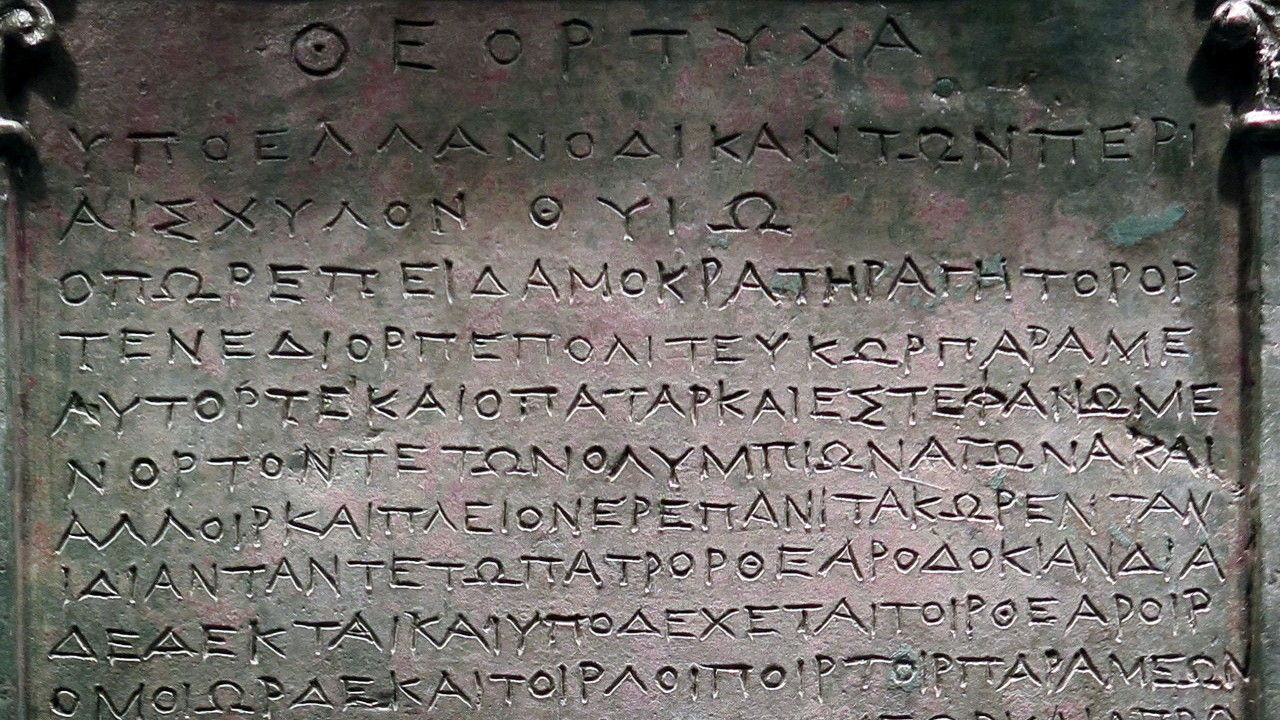
Attic/Ionic dialect, Plato, Timaeus - c.a 360 BC
Such was the whole plan of the eternal God about the god that was to be, to whom for this reason he gave a body, smooth and even, having a surface in every direction equidistant from the centre, a body entire and perfect, and formed out of perfect bodies. And in the centre he put the soul, which he diffused throughout the body, making it also to be the exterior environment of it; and he made the universe a circle moving in a circle, one and solitary, yet by reason of its excellence able to converse with itself, and needing no other friendship or acquaintance. Having these purposes in view he created the world a blessed god.
Doric dialect, Herakleia (Magna Grecia), Italy, 4 th century BC
The renters of the fields will grow as follows: the one who rented the first field will plant at least ten units (land) of vineyard and will plant at least four olive trees on each unit of land that is suitable for olive trees.
Aeolic dialect, Pelasgiotis, Thessaly, 214 BC
When this has been done and everybody stays together thanks to the priveleges granted, he (Philip V of Macedon) is convinced that there are many other benefits for himself and the city (of Larissa) and that there will be a better use of the land.
Arcadocypriot dialect, Koureion, Cyprus, 6th century BC
e we se · i to i · pi lo ku po ro ne we te i to o na sa ko ra u · pa si
le u se · sa ta si ku po ro se · ka se a po to li se · e ta li e we se · a no
ko ne o na si lo ne · to no na si ku po ro ne to ni ja te ra ne · ka
se · to se · ka si ke ne to se · i ja sa ta i · to se · a to ro po se · to se · i ta
· i · ma ka i · i ki ma me no se · a ne u · mi si to ne
When the Medes and Ketians were laying siege to the city of
Edalion in the year of Philokypros the son of Onasagoras, King
Stasikypros and the city of the Edalians instructed Onasilos
the son of Onasikypros, the physician, and his brothers to treat the
men wounded in battle, without payment.
Macedonian, Pella, 4th century BC
Of Thetima and Dionysophon the ritual wedding and the marriage I bind by a written spell, and of all other women, widows and maidens, but of Thetima in particular, and I entrust upon Makron and the daimones. And that only whenever I dig out and unroll and re-read this, then may they wed Dionysophon, but not before; and may he never wed any woman but me; and may I grow old with Dionysophon, and no one else. I am your supplicant: Have pity for [Phil?]a, dear daimones, for I am bereft of all my dear ones and abandoned. But please keep this for my sake so that these events do not happen and wretched Thetima perishes miserably but let me become happy and blessed.
Pamphylian dialect, Sillyon (gulf of Antalya), 4th century BC
σὺ Δι̣ϝί̣ᾱ̣ καὶ ℎιιαροῖσι Μάνεˉ[ς ․]Υ̣ ἀ̣νℎε˜ˉλε Σελυͷ[ι]ι̣υ̣ς̣ [—3.5—]
ΙΑ․Α ϝί̣λ̣σιιο̣ς̣ ὕπαρ καὶ ἀν̣ίιας ὅσᾱ περ̣<ι>ί[στα]-
τυ̣ ͶΟΙΚ[—4.5—]ΙΣ[—5—]ΤΥ κα̣ὶ Σελυͷιιοˉς ΠΑ․ΙΡΑ[—2—]Π[—4.5—]
ΙΣ̣ΑΠΑ κεκραμένοˉς, ἐξ ἐ[πι]τεˉρ̣ίιᾱ ἰς πόλιν [Α(?)—7.5—]
διιὰ πέδε καὶ δέκα ϝέτ̣[ι]ια, πό̣λι μℎε[ι]ά̣λα̣ [—4—]ΔΙ(?)
ΟΣΑ καὶ τιμάϝεσά ποˉς ἄβατι ἀ̣φιιέναι Κ̣Α̣․ΙΛΛ[—4.5—]
ἀτρόˉποισι περτ<ὶ> ἴρεˉνι ἀͷταῖσι ℎεˉͷόταισ̣ι̣[— —11— —]
ἐβοˉλάˉσετυ ἀ̣δριιο˜ˉνα καταστασ[— —17.5— —]
ΡΑΙΕ ℎῖκ̣αι Μℎειάλεˉτι κ̣α̣ὶ ἐφ̣[ι]ι̣εˉͷοται[— —15— —]
ΠΑΣ Μάνεˉτυς̣ κ̣αὶ Μℎει̣ά[λεˉ]τυς καὶ ΔΙ[— —16— —]
ΟΕϜΕ ἰ π̣όλιι ἐφιέλοδυ [—2.5—]ι̣ δι̣κ̣αστέˉρεσσ̣[ι καὶ ἀργυροˉ]-
ταῖσι καί νι σκυδ̣ρ̣ὺ κατεϝέρξοδυ καὶ [— —14.5— —]
κάθεδυ καὶ ℎάιι<α> ἀνεῖε̣ κ̣αὶ ὑ βοˉλέˉμενυς̣ Φ(?)[— —15.5— —]
[κ]αί νι ͷοῖκυ π[ό]λις̣ ἐχέτοˉ καὶ ℎΟΚΑ ΔΕ[— —17.5— —]
ΑΣ ͷρυμάλι<α> ἀν̣ℎαγλέˉσ̣θοˉ. ℎ<ὰ> ἀτρέˉκαδι [— —16— —]
δικαστε˜ˉρες καὶ ἀργυροˉταὶ μὲˉ ἐξάγοˉδι Κ̣[— —c.13.5— — σπ]-
απιροˉτὰς καθανέτοˉ καί νι ͷοῖκυ πόλ[ις —c.7—]
στε˜ˉες δὲ καὶ ἀργυροˉταὶ ΑΝΕΑΝΕ[— —18— —]
ΑΜΙΙΕΣΔΥ ἐξ δὲ ΦΥΣΕΛΑ ἴοδυ. δικ̣α̣στεˉρες̣, [— —16.5— —]
ΑΣ γένοˉδαι, ℎΑΙΡΕ μὲˉ ἐ[ξά]γοˉδι Κ[—3.5—]ΝΕΣΑ[— —16.5— —]
ΟΔΥ ΑΜΑΤΙΡΕΕ μℎε[—8—] ἀπ[ὺ] ἐ̣ͷπρα[— —16— —]
ΕΣ περὶ γέρας ℎιιαρ̣ὺ [—6—]εˉται καί νι θέδ[υ — —16.5— —]
ϝℎε καὶ Μℎειάλεˉ κ̣αί̣ ν̣[ι] ΣΑΜΑΔΙΜΟΣΑΜΑΛ[—5.5—]ΟΙΣΙ
πόλις ἄγεθλα ΦΕΕΤΟ καὶ σπαπι[ρ]οˉ̣τὰς βόϝα καιν[έ]τοˉ καὶ π-
όλι καὶ ΟΡΟϜΥ καὶ [— — —c.27— — — ἐ]πέθ̣εˉκε [—4.5—]
ΙΚΟ κε˜ˉσθαι ΠΕΡΑͶ[— — —27— — —]ΑΣΕ[—2.5—]ΛΙ
ἰσϝέξεˉ καθ̣ανέ[τοˉ — — —c.28— — —]ΕΧΕΤ[—2.5—]
ΕΣΦΑΙ[—3—]Α̣ΤΕ․ΛΙΙ[— — —32— — —]ΙΙ[—6.5—]
ΟΙΣΙ πόλ̣ις ΟΜΥΣΥ[— — —c.27— — — Ͷ]άναα
30 καὶ Ἀπέλοˉνα Πύτ[ιιυ — — —c.27— — —]Ϝ?ΑΙΕ?ΠΕΡ
[γέρα]ς̣ ℎιιαρὺ ℎΑΙ[— — —29— — —]ΥΣ[—3.5—]Ε?Ο
[—8.5—]ΕΡΟͶΟΙΜΕΙ[— — —28— — —] καὶ ΕΔ?ΙΟ
[—6.5—]Ο̣ΔΥ ΠΑͶΡΙΖ[— — —28— — —]ΚΙΣ․ΙℎΑ
[—4—]Ͷ̣ΤΑ κατέχοδ[υ — — —c.28— — —]ΕΧΕΣΙΙ̣Υ̣
35 [—5.5—]Α․Α καὶ Τ[— — —c.28— — — ℎεˉ]ͷ̣ότας Α
[—6—]ΤΑΣ.
With the help of Diwia and the priests, Manes [son of ...] of
Sillyon ordered sacrifices on account of the oppression and
distress which afflicted the dwellings [...] and the Sillyonians, who
had been devastated [by ...], because of his solicitude for the city,
[troubled] (5) for fifteen years: to release in some way the city,
which was (formerly) great [...] and honoured, from its
misfortune [...] For the adult men, with a view to peace, together
with the youth [...] he decided to establish a men’s club-house [...]
for Megales and the young men to come [...] (10) every [ follower ]
of Manes and of Megales [...] in the city let them elect both judges
and treasurers, and let them quell anger and [...] restore [...]
and put an end to sacrilege; and anyone who wishes [...] And
the city is to own the building, and whoever [...], that party (15)
is to undertake the responsibility for its upkeep. The matters
they have examined [...], the judges and treasurers are not to
release ...
Gallery
Sources & Further reading
- Francisco Rodríguez Adrados, "A history of the Greek language: from its origins to the present", Brill 1999
- R.J Hopper, The early Greeks, Barnes & Noble 1977
- John Chadwick, "The Mycenaean world", Cambridge University Press 1976
- David W. Anthony, "The horse, the wheel and language", Princeton University Press 2007
-
John Boardman, I.E.S Edwards, N.G.L Hammond, E. Sollberger, "Cambridge Ancient History Vol. 3", Cambridge University Press,
2008
- Margalit Finkelberg, "Greeks and pre-Greeks", Cambridge University press 2005
- Julián Méndez Dosuna, "Ancient Macedonian as a Greek dialect: A critical survey on recent work", Thessaloniki 2012
- R. Whitney Tucker, "Chronology of Greek Sound Changes", The American Journal of Philology, Vol. 90, No. 1 (Jan., 1969)
- Colvin, Stephen, "A historical Greek reader: Mycenaean to the Koiné", Oxford University Press, 2007.
Tags: Greek, Greek language, Greeks, Greece, Helladic, Aegean, Minoans, Pre-Greek, Greek dialects, Ionic, Aeolic, Doric, Ancient Macedonian, Arcadian, Cypriot, Pamphylian, Hattic, Hurrian, Western Anatolia, Balkans, Indo-European