The Thracians and their language
If names like Orpheus, Spartacus or Justin I sounds familiar to you, then you’ve heard of at least one famous Thracian in your life. Thracians were people living in the eastern Balkan peninsula and were speakers of at least one Indo-European language. They were the definition of a barbarian and the second most numerous nation on earth.Geography of Thrace
Their land can be approximately defined as northeastern Greece, European Turkey, Bulgaria, eastern Serbia and Romania. In the southwest around the river Axios (Vardar) they had their early borders with the Greeks. In the west they were bordering with the Paiones and the Dardanians. In the lower course of the Danube river were their boundaries to the Scythians. Thracian tribes certainly migrated into north-western Anatolia during the first centuries of the first millennium B.C, for example the Bithynoi (Str. 295), and such movements may well have begun at the end of the Late Bronze Age.Prehistoric Thrace
The earliest traces of man in Thrace go back to Palaeolithic times, forty thousand years ago. Around the 7th millenium BC, agricultural populations belonging to the Balkano-Anatolian complex are settling in the Balkans. They had many similarities with the pre-Indo-European-Anatolian cultures and especially with that of Hacilar. During the Eneolithic period (that is to say the period of transition from late neolithic to early bronze age), the first wave of Indo-Europeans enter the Balkans. Amongst those people were probably the proto-Indo-European ancestors of the Greeks, Phrygians and Armenians. Yet, at this remote period we can not identify the early Thracians. Later, the bearers of the Middle European Hiigelgraber or tumulus culture exerted towards southern Pannonia a pressure which played an outstanding role in the formation of the Dubovac-Zuto Brdo group and in the connexions it had with the west Pannonian incrusted ware. Meanwhile the Noa-Sabatinovka group moving westwards from the east towards the Carpathian region exerted pressure in the Lower Danubian area. While this process was going on, it is understandable that a considerable regrouping and assimilation of various groups took place, accompanied by geographical movement. It was by the symbiosis of the Indo-Europeans and the autochthonous populations and thence by a lengthy process of historical, economic and social development, that Thracians developed so that they were readily identifiable in the written sources of the first millennium B.C.Thrace from the 13th century BC to the Roman conquest
Thracians probably made themselves famous at the end of the 13th century BC. Homer, in his Iliad mentions them as Trojan allies:“If you want to find your way into the host of the Trojans, there are the Thracians, who have lately come here and lie apart from the others at the far end of the camp; and they have Rhesus son of Eioneus for their king. His horses are the finest and strongest that I have ever seen, they are whiter than snow and fleeter than any wind that blows. His chariot is bedight with silver and gold, and he has brought his marvelous golden armour, of the rarest workmanship- too splendid for any mortal man to carry, and meet only for the gods. Now, therefore, take me to the ships or bind me securely here, until you come back and have proved my words whether they be false or true.”
![Thracian rock carving of a dancing man, dated to the late bronze age [Goniko, Ebros, Greece].](/assets/Thracian/rockscripts.jpg "Thracian rock carving of a dancing man, dated to the late bronze age [Goniko, Ebros, Greece].") Hesiod knew Thrace as the land from which cold northern winds came to Greece. Around 650 BC, Archilochus is the earliest Greek writer to mention Thracians as an evidently contemporary people.
Hesiod knew Thrace as the land from which cold northern winds came to Greece. Around 650 BC, Archilochus is the earliest Greek writer to mention Thracians as an evidently contemporary people.
About 700 B.C. Greek emigrants began planting colonies (amongst them was also Byzantium) along the strip of Thrace that borders the northern Mediterranean and the Black Sea. By 600 B.C. a line of Greek cities had been firmly established and an active trade developed between them and the Thracians in the hinterland. From that point, our perspective about Thracians gets wider. The father of History, Herodotus, decided to give us a detailed description of their profile.
Thracians believed in immortality and had some really alien to us today habits. Men could have many wives; so many that this custom entered one of Menanders comedies:
“ten, eleven, twelve, even more. Why, back home, any poor devil who has only four or five wives doesn't even count as married.“
When the man died, his wives competed as to who had been his favorite. The winner gained the “privilege” of getting killed and being placed next to her husband.
In their ceremonies, the guest drunk wine from horns, while the music according to Xenophon’s account was like “trumpets of raw oxhide”. Men performed a dance where they mimed a duel with sabers. The fighting was so persuasive that when one of them fell down, the audience really believed that he was really dead. There was however another entertainment that often caused death. The Thracian equivalent of Russian roulette: A man clutching a Thracian short sword would stand on a stone and put his head in a hangman's noose. Someone would kick the stone away, and the trick was to slash the cord before it was too late.
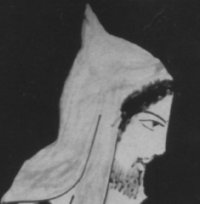
It is also reported that they were selling their kids into slavery abroad. That’s why aristocratic Greek households had servants named Thratta (Gk. for Thracian woman) or Geta (from Getae, an important Thracian tribe). Although they were described having an exotic look, being tall, grey-eyed and either fair-haired or red-haired, this has been not confirmed by recent studies which showed that Thracians shared similar characteristics with Greeks, Albanians and Italians. During the 5th century BC, Thracians make a big impact on the Greek society. They are literally everywhere, from Athens, to Macedon, to Crete and the other Islands. They are mainly serving as mercenaries in Greek armies. The Hellenisation of the Thracians had gone so far, that according to Xenophon’s account, at Thracian court banquets even the servants could take directly orders in Greek. However in Thrace, tribes continued to fight each other. Eventually, around 420 B.C., a king named Sitalkes managed to subjugate the whole country, not excepting the Greek cities along the coast, which put him in a position to play a hand in international politics. After Philip II of Macedon and Alexanders conquests the Greek part of Thrace along the shore was affected-but not the interior, where the tribal leaders maintained their independence and with it the freedom to carry on their interminable fighting with each other. In the second century B.C., Rome, made its weight felt in the area. All they required from the various Thracian chieftains was the right to recruit cavalrymen and peltasts to serve with the Roman armies and the opportunity to acquire slaves. During the great days of the Roman Empire, no program of gladiatorial combats was complete without a duel in which a “Thrax” took part. The one gladiator most of us know by name, Spartacus, was a Thracian.
The language of the Thracians
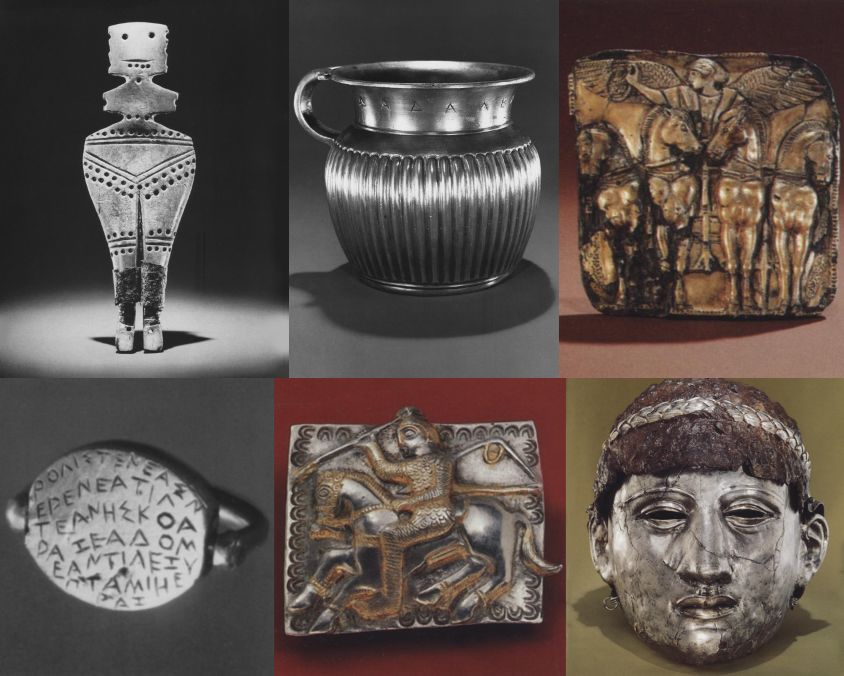
The Thracian language is scarcely attestedTheir total number is according to Detschew (1957) seventy, of which he himself regarded about twenty as doubtful. According to Georgiev (1981), they are about forty, while Duridanov (1976) puts their number at twenty-four. Velkova (1986) considers thirty glosses to be “definitely Thracian” and twenty-two as “probable or doubtful Thracian”. We have 1500 recorded names, which are divided into more than 400 place names (Toponyms), 60 river names, 20 names of mountains, more than 700 personal names, around 160 names of gods (Theonyms) and 80 ethnic names and survives only through few inscriptions(1) the Ezerovo inscription; (2) the inscriptions from Duvanli; (3) the inscriptions of Kjustendil; (4) the Samothrace inscriptions (still unpublished). None of these inscriptions has been satisfactorily interpreted. and glosses recorded by ancient authors. This makes its classification within the Indo-European languages very difficult. Was it a centum or satem language? Was it closer to Greek or Baltic languages? Was Dacian a Thracian dialect or a closely related language? Those are the issues that we’re gonna discuss below.
Back in time, it was believed that Thracian, Illyrian and Phrygian shared a development which showed that they were still closely related in late prehistoric times: a 'sound-shift' which had affected the occlusive consonants ('stops') of Indo-European. We know now that Phrygian was a centum language, however, Thracian and Dacian have one of the main satem characteristics, the change of IE *k and *ĝ or *g to s and z. Some other satem characteristics though are doubtful or completely missing which leads us to the conclusion that the development of satem characteristics was a late change in central or residual dialects of Indo-European, such as Thracian and Dacian. That means that although Thracian was a satem language in classical years, proto-Thracian might have been centumSorin Mihai Olteanu - The Thracian Palatal. Those partially satem characteristics and the similarities of Thracian to the Baltic group suggest that an ancestral Thraco-Dacian people was settled in Dacia until part of it migrated into Thrace.
Another big issue within Thracology is whether the people of Dacia were Thracians or not. It might have been that the Thraco-Dacian area was inhabited by tribes, speaking closely related tongues, with differences that are enough to classify them as different languages and not dialects. For example differences between the ancient place-names of Dacia and Moesia on the one hand and Thrace on the other indicate that the native idioms of the two former areas diverged somewhat from those of the latter in vocabulary and word formation. In Dacia name of towns are formed with the suffix -deva/-dava while place names ending in -bria, -para, -sara are confined in to southern Thrace. On the other hand, evidence seems to indicate divergence of a 'Thraco-Dacian' language into northern and southern groups of dialects, not so different as to rank as separate languages, with the development of special tendencies in word formation and of certain secondary phonetic features in each group. In ancient times, Strabo states that the Dacians spoke the same language as the Getae and later he states that the Getae spoke the same as the Thracians, which means that more or less Dacian was Thracian. However, Strabo was a geographer not a dedicated linguist that we can rely on with full confidence. For practical reasons, Palaeolexicon is grouping Dacian within Thracian, without however taking a definite side on the nature of Dacian (dialect or sibling language).
The position of Thracian within the IE languages is also uncertain. There is evidence, that links Thracian to Ancient Greek, Albanian as well as the Baltic languages. It is easier however to start with what Thracian was not.
a) Thracian was not Phrygian (or the opposite). In the past many linguists grouped Thracian in one group with Phrygian (Thraco-Phrygian). However, Phrygian is a centum language with such an affinity to Greek that it is evident both languages had a common pre-historic background.
b) Thracian was not Illyrian. A grouping of Illyrian with the Thracian and Dacian language in a “Thraco-Illyrian” group or branch, an idea popular in the first half of the 20th century, is now generally rejected due to a lack of sustaining evidence, and due to what may be evidence to the contrary. Also, the hypothesis that the modern Albanian language is a surviving Illyrian language remains very controversial among linguists.
So, what about Baltic?
In the 70s Ivan Duridanov presented a respected workDuridanov, Ivan. “The Language of the Thracians”, Nauka i izkustvo, Sofia (1976)., where he proposed the connection of Thracian with the Baltic languages. Indeed a number of cognates seem to exist between Thracian and the Baltic languages, e.g: Thr. Sautes = lazy ->Latv. Sautis = lazy man, Thr. Zibythides = nobble Thracians ->Lith. Zibute = shining. Although the cognates are many, no conclusive evidence exists that can support a very close relation between Thracian and Baltic. Also, the few Thracian inscriptions that exist are not apparently close to Baltic.
What about Ancient Greek?
Sorin M. Olteanu, the Romanian thracologist who suggested that early Thracian was a centum language that later changed to satem, proposed the connection to Ancient Greek, though a number of cognates (including a substratum of words in Romanian).
One example of the remote kinship of Greek and Thracians is a word that appears in the inscription of Flavius Dizalas, son of Ezbenis (IGB b4.2338). Ζραικῆς (referring to a Thracian strategy) as rendered in Greek, read as Zrayka in Thracian and could have been the native Thracian word for the ethnonym “Thracian”.
Based on the theory of the late satemization of Thracian and the IE sound-laws, the semi-satem version of Zrayka should be ġrayk(o) (same root as one of the ethnonyms of the Greeks).
The question that remains in such cases is, whether such evidence signifies remote kinship or a generic common Indo-European ancestry?
The discovery of ~300 inscribed ceramic items from Zone, Samothraki has reignited the the discussions about the relationship of Thracian with Greek. However, most inscriptions remain unpublishedWith exception of those few published in Brixhe, Claude. "Zôné et Samothrace: lueurs sur la langue thrace et nouveau chapitre de la grammaire comparée?." Comptes rendus des séances de l'Académie des Inscriptions et Belles-Lettres 150.1 (2006): 121-146.
leaving us with nothing else than speculations. In fact, the language of the inscribed objects remains unknown and could even be unrelated to the language spoken in Thrace proper.
What about Albanian?
Even though, Illyrian has been the first language to be compared to Albanian, Thraco-Dacian is the strongest contestant.
A number of linguists have been examining the possibility of Albanian being a descendant of a Dacian relic.
The initial Roman conquest of part of Dacia did not put an end to the language, as free Dacian tribes such as the Carpi may have continued to speak Dacian in Moldavia and adjacent regions as late as the 6th or 7th century AD, still capable of leaving some influences in the forming of Slavic languages.
According to the hypothesis of Hasdeu (1901), a branch of Dacian continued as the Albanian language.
A refined version of that hypothesis considers Albanian to be a Daco-Moesian dialect that split off before 300 BC, and that Dacian became extinct.
Strong evidence to this theory is the shared substratum of words in Romanian and Albanian.
The Thraco-Dacian Phonology
| Proto-Indo-European | Thracian | Comments |
|---|---|---|
| *p | p | |
| *b | b | |
| *bh | b | PIE *bʰrū‑to‑ > βρῦτος [brûtos], Βέβρυκες < PIE *bhebru |
| *t | t ~ thThe presence of voiceless aspirates in some morphemes could have a different explanation, e.g. the morpheme ‑ινθος [inthos] in βόλινθος [bólinthos], Πέρινθος [Périnthos] and its probable relationship with Pre-Greek Non-IE ‑ινθος [inthos] | brento 'stag', -κενθ-, -centh- |
| *d | d ~ t | Burd(i)-, Burtudizos |
| *dh | d | δάκινα < *dhauk-ino-s, -διζα < *dheiĝh- |
| *k̂ | s | Asamus < *ak̂(a)m-yo- "stony", Σουρο- & Συρο in personal names from PIE *k̂uro |
| *ĝ | z | rn Αρζος < PIE *ar(e)ĝ- 'white' |
| *ĝh | z, θ (in Dac. before l) | pn Ζεύθης < *ĝheu-te(r), βουδάθλα < *dn̥ĝhla |
| *k | k, kh (Thr) - k ~ tz ~ s ~ z (Dac.) | Thr. βρυγχόν, Thr. Κίντος ~ Dac. Tzinta |
| *g | g (Thr) - g ~ dz ~ z (Dac.) | Dac. Ζερμιζίργα |
| *gh | g | PIE *gu̯ʰen‑to > γέντον [génton] |
| *kw | k, kh | |
| *gw | g, k | PIE *gwelna "source" > Κελλαι/Κελλη |
| *gwh | g - z (Dac.) | PIE *gwhen‑to > γέντον [génton], gwherm- > Thrac. Γερμ-/germ- Dac. Ζερμ- |
| *s | s ~ z | Intervocalic s changes to z sometimes e.g. Ezbenis and Asbenoi, which points to a later development. |
| *y | y | |
| *w | ø ~ b | Becomes b after s/z (PIE k̂ e.g. hek̂w- > εσβ-/εζβ-) and before r (PIE *wriyā > βρια) |
| *m | m | |
| *n | n | |
| *l | l | |
| *r | r | |
| *m̥ | um | |
| *n̥ | un | |
| *l̥ | ul | |
| *r̥ | ur (Thr.), ri (Dac.) | Burd-apa < *bhr̥d, Dac. rn Κρίσος < *kr̥sos |
| *i | i | |
| *ī | ī | |
| *e | e, ie ~ ia (Dac.) | When accented in Dacian becomes ie ~ ia, διέλλεινα < *dhel-ēna, σκιάρη < *skerā |
| *ē | ē (Thr.), a (Dac.) | Thr. Ρήσος, Dac. -dava < *dhēwā |
| *o | a | σκάλμη < *skolmā |
| *ō | ō/ā | The shift to ā is debatable. |
| *a | a | |
| *ā | ā | |
| *u | u | |
| *ū | ū | |
| *h1 | ø | |
| *h2 | ø | |
| *h3 | ø | |
| *h4 | ø |
Sample texts in Thracian with translation
The three following inscriptions have uncertain interpretation.SEG 45:835
Raw text: ΔΑ ΔΑΛΕ ΜΕ
Transliteration: Da dale me
Translation: Da (Demetra), protect me!
The golden ring of Duvanli
Raw text: ΗΥΖΙΗ ΔΕΛΕ ΜΕΖΗΝΑΙ
Transliteration: ēusiē dele mezēnai
Translation: Horseman Eusie protect!
SEG 38:733
Raw text: ΡΟΛΙΣΤΕΝΕΑΣ NΕΡΕΝΕΑ ΤΙΛΤΕΑΝ ΗΣΚΟ ΑΡΑΣ ΖΕΑ ΔΟΜΕΑΝ ΤΙΛΕΖΥΠΤΑ ΜΙΗ / ΕΡΑ ΖΗΛΤΑ
Transliteration: Rolisteneas Nerenea tiltean ēsko aras zea domean Tilezupta miē era zēlta.
Translation: I am Rolisteneas, a descendant of Nereneas. Tilezipta, an Arazian woman, delivered me to the ground.
Gallery
Sources & Further Reading
Boardman, Edwards, Hammond, Sollberger, “Cambridge Ancient History III - The Prehistory of the Balkans and the Middle East and the Aegean world, tenth to eighth centuries B.C”, Cambridge University pressLionel Casson, “The Thracians”, The Metropolitan Museum of Art Bulletin 35.1 (1977): 3-6.
Georgiev Vladimir, “The Genesis of the Balkan Peoples”, The Slavonic and East European Review (1966): 285-297
Georgiev Vladimir, “Trakite i texnijat ezik”, Sofija: Izdatelstvo na balgar-skata akademija na naukite (1977).
C. Brixhe, Panayotou A., “Le Thrace” in Bader, F. “Langues indo-européennes”, CNRS éditions, Paris 1994
Christos Tzitzilis, “Greek and Thracian”, in: Encyclopedia of Ancient Greek Language and Linguistics, Consulted online on 10 October 2016
Orel, Vladimir Ė. A concise historical grammar of the Albanian language: reconstruction of Proto-Albanian, Brill 2000
Katicic Radoslav, “Ancient languages of the Balkans. No. 1”, Walter de Gruyter 1976.
Sorin Olteanu, “The Thracian Palatal”, (Accessed: January 14, 2009)
Dimitrov P. ,“The Thracians and Their Neighbors.”, Thracia XVI. In honorem X congressus studiorum Thracicorum Graecia (2005): 59-65.
Detschew, D., “Charakteristik der thrakischen Sprache”, 1960 Linguistique Balkanique 2:147-212.
Russu, I. I., “Limba traco‑dacilor”, 1969 Bucarest
Venedikov, Ivan. “The Archaeological Wealth of Ancient Thrace.” Metropolitan (The) Museum Art Bulletin New York, NY 35.1 (1977): 7-72.
Georgeta, Cardoş, et al., “Paleo-mtDNA analysis and population genetic aspects of old Thracian populations from South-East of Romania.” Rom. Journal of Legal Medicine 12 (2004): 4.
Tags: Thracian, Thracian language, Thrace, Orpheus, Dacians, Dacian language, Balkans, Greece, Bulgaria, Satem, Palaeo-Balkan languages